

Circular Signals #06
Before we ask organisations to prove impact, we should ask a simpler question: What evidence do they have to work with?
Across Europe, thousands of garments are repaired, resold, rented and restored every day.
The activity exists.
The evidence is often fragmented.
Receipts.
Spreadsheets.
Internal notes.
Individual databases that don’t speak to one another. Yet, we continue asking organisations to demonstrate impact through reports, funding applications and complex sustainability disclosures.
Perhaps we’ve skipped a step.
Perhaps the first challenge isn’t measuring circularity.
It’s ensuring that daily operations generate reliable circular fashion impact evidence in the first place.
Circular Activity isn’t Rare…
Reliable evidence is.

When people talk about the circular economy, the conversation often focuses on increasing participation.
More fashion repair.
More resale.
More rental.
More take-back programs.
But after spending time with organisations across the ecosystem, another question keeps coming back:
How much of that activity can actually be demonstrated?
Not estimated.
Not reconstructed months later.
Demonstrated.
That question matters because decisions are increasingly being made on the strength of verifiable records.
Funding.
Strategic Partnerships.
Procurement.
Policy.
All of which rely on data. Without credible circular fashion impact evidence, valuable work becomes invisible labor; difficult to understand, compare and communicate.
Reporting starts long before reporting starts
Most sustainability reporting happens retrospectively.
Organisations are asked to demonstrate months of operational activity using whatever records happen to exist.
By then, details have already been lost.
Repairs have been completed.
Products have changed hands.
Garments have stayed in use.
The work happened, but the evidence didn’t always survive. Circular fashion doesn’t simply need better reporting. It needs better ways of capturing activity as it happens.

Frameworks are only as good as the Information they Receive
- Digital Product Passports.
- Product Environmental Footprints.
- Life Cycle Assessments.
- Green Claims requirements.
Each framework plays an important role. But none of them removes the need for reliable records.
No framework can measure activity that was never captured at the moment of execution.
Evidence is Becoming Infrastructure
Infrastructure isn’t only physical.
It’s also informational.
Roads move vehicles.
Digital infrastructure moves information.
Building a robust system for circular fashion impact evidence allows organisations to understand, communicate and improve what they’re already doing.
As circular fashion matures, evidence won’t simply support reporting.
It will shape investment.
Commercial partnerships.
Procurement.
Policy.
And customer trust.
That’s a much bigger idea.
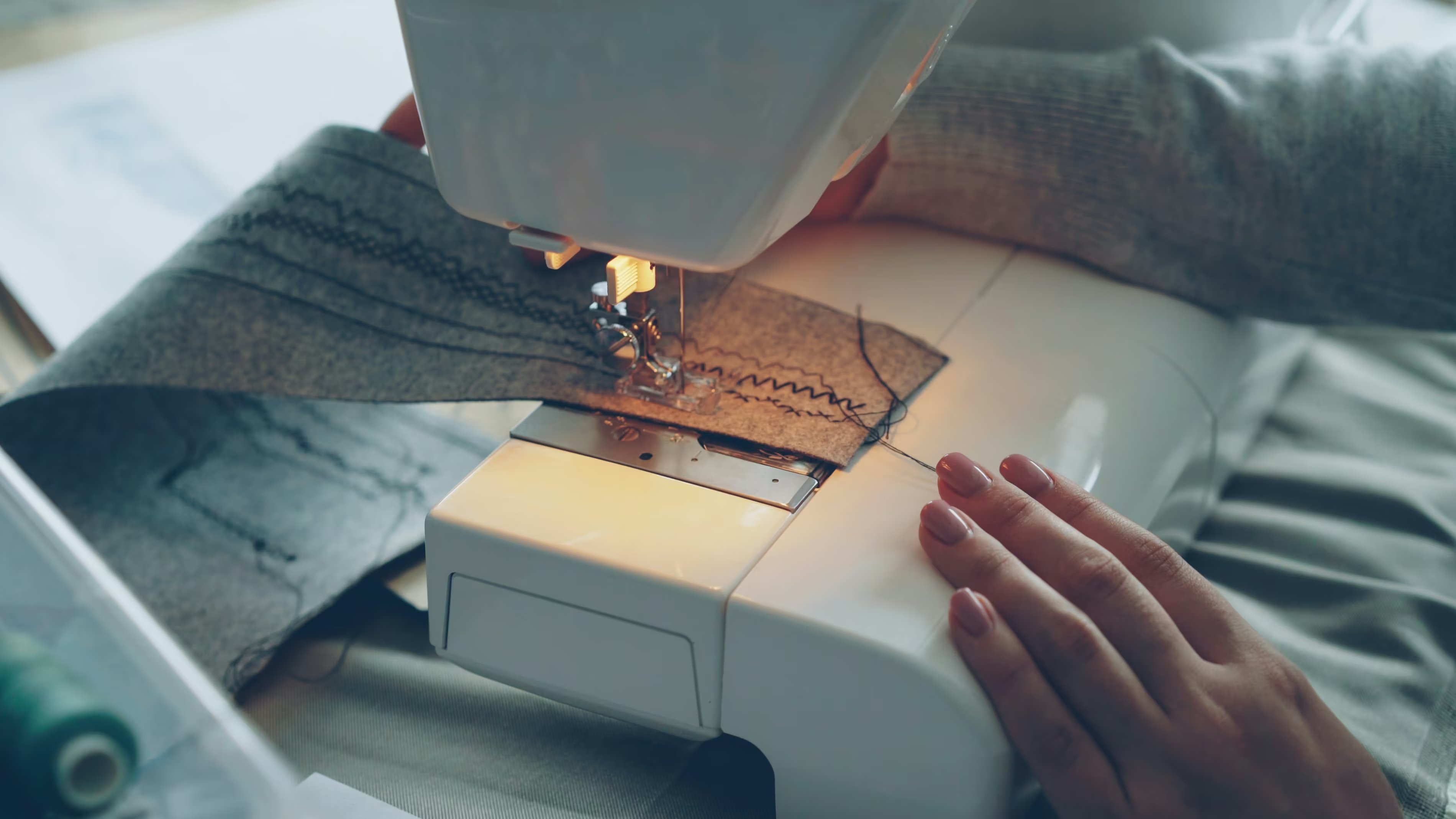
At Tuleva, we are interested in what happens before the report.
When an item is repaired, resold, rented or redesigned, that activity should leave a reliable record while the work is happening; not months later when someone is trying to reconstruct what happened.
That evidence can then support impact measurement, reporting and the decisions that follow.
And then your next paragraph:
If Europe wants to lead this transition, should we be expecting circular fashion to prove its worth through systems designed for the old linear model?
Or is it time to build an evidence ecosystem that actually reflects how circularity works, making it easier to not leave evidence behind?
That’s the conversation Tuleva is here to explore.